
Building a “super team” in biotech, honestly
Updated on : 1st May 2026
Teams do not fail because of a lack of intelligence or effort. They fail because of misalignment, poor decisions made under pressure, and a lack of clarity about what they are trying to build. This was the consistent thread running through a panel at BioTrinity this year, and it is a clearer framing than the usual conversations about talent, culture and diversity. Having scaled a company to 100+ headcount and advised countless leaders over 20 years in executive search, I believe it is possible to be concrete about this.
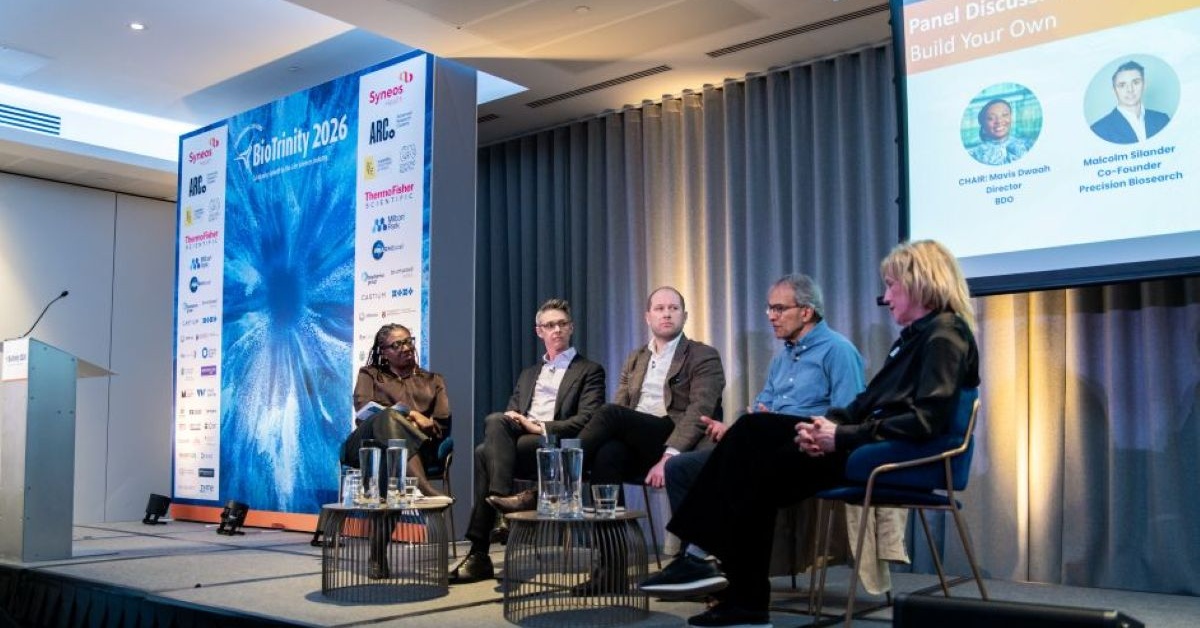
The discussion, moderated by Mavis Dwaah, Director at BDO and leadership specialist, brought together Angela Hobbs, Innovation Coach; Dr Uday Phadke, Founder of Triple Chasm; Mark Milsted, founder of Performance Method; and other contributors.
At the centre of this is something simpler, and harder: the internal authenticity of the leader. If a leader is not clear on who they are, how they behave, and what they truly value in practice – not just want they aspire to – it becomes difficult to create clarity for others. That includes the leadership team and the wider organisation. Without that clarity, alignment does not follow.
No single model, only clarity
There is no single model for a high-performing team. There are many different ways to build an effective organisation. What matters is not the model itself, but whether it is understood and consistently applied.
In practice, that means being honest about how the team behaves, reflecting the leader. Some teams are collaborative, open and flexible, built around shared ownership and broad input. Others are more directive, execution-led, with pace and intensity at the centre. Both can work. The difference is whether that operating model is clearly defined from the outset and whether people joining the organisation understand what they are stepping into.
Where that authenticity exists internally, it creates clarity externally. Where it does not, gaps begin to appear between what is said and what is experienced.
Where the gaps actually appear
Uday, drawing on his experience scaling science and technology businesses, framed this in terms of context. Teams need to understand not just the science, but the full journey from discovery through to product, regulation and commercialisation. Early-stage companies are often heavily weighted toward scientific capability. That is necessary, but not sufficient. Without expanding that perspective, teams struggle to evolve.
Hiring is where these issues tend to surface most clearly. Most poor hiring decisions are not obviously wrong at the time. As discussed, “what goes wrong is when you are hiring for the wrong reasons… often people don’t even know what those reasons are.”
That usually means reacting to pressure, solving for short-term gaps rather than long-term need, or allowing too many stakeholders to influence decisions without clear ownership.
Diversity of thought follows the same logic. The evidence for it is strong, but it only holds where leaders are genuinely open to challenge. A leader who claims to want diverse perspectives but consistently overrides them is not unlocking that potential.
Leadership capability itself is often misunderstood, particularly in early-stage biotech. Many founders come from scientific or technical backgrounds and are then expected to lead growing organisations.
“Not everybody is designed to be a people leader. It’s an entirely different skill set and an entirely different job to the technical day job. And there can be an honesty about saying one is or is not cut out for it, but there are also ways around that.” That honesty is critical. It allows leaders to either invest in developing those capabilities or build teams around them that compensate for the gap.
What tends to cause problems is not the gap itself, but the failure to recognise it.
Angela and Mark made related points around scaling leadership alongside the science. As companies grow, the demands on leadership shift significantly, and capability can be developed with the right focus and support. It comes back to understanding who you are as a leader and being clear about what the organisation needs next.
Communication underpins this. It is often described as a soft skill, but in practice it is the system through which alignment is created and maintained. Clarity of message, repeated consistently and reinforced through behaviour, is what allows teams to operate effectively as they scale.
What defines a “super team”
Ultimately, the strongest teams are not defined by structure, cultural labels, or even individual talent. They are defined by coherence.
That coherence starts internally. It requires leaders to be clear on their own motivations, their own behaviours under pressure, and the kind of team and organisation they are building.
From there, clarity can be communicated externally. Expectations become explicit. Hiring becomes more deliberate. Decisions become more consistent.
If there is one question that underpins all of this, it is a simple one: why does the company, honestly, exist? It is rarely answered clearly enough, but it shapes everything that follows. When answered with self-awareness and sincerity, it is the foundation everything else is built on. Without it, even the most talented teams are built on sand.
In biotech, exceptional science is the starting point, not the finish line. Turning it into something real requires a team that can execute, adapt, learn and scale. That kind of team does not build itself. It is the product of leaders who know who they are, say what they mean, and build organisations that reflect both.
Latest News